Choosing the right Rubber Bumpers in 2026 requires more than comparing prices or browsing attractive product photos. Global buyers must examine material quality, dimensional accuracy, load performance, and supplier reliability. A bumper used on a laboratory cabinet faces different demands from one installed on a truck step or industrial enclosure.
Small details matter. A few millimeters can change contact stability. A soft compound may reduce vibration effectively, yet deform under continuous pressure. A harder grade can support heavier loads, but transmit more impact noise. Temperature, oil exposure, ultraviolet light, moisture, and cleaning chemicals also influence service life. These factors deserve practical testing, not assumptions.
This guide evaluates popular Rubber Bumpers for international purchasing teams, equipment manufacturers, maintenance professionals, and distributors. It considers rubber type, hardness, shape, mounting method, compression behavior, and available customization. Supplier experience matters too. Reliable manufacturers should provide consistent samples, clear technical data, traceable quality checks, and realistic production timelines. Certificates can support a decision, but they do not replace product testing.
Performance comes first.
Even experienced buyers can overlook packaging damage, tolerance variation, or changing raw-material quality. That is why a small trial order often provides valuable evidence before full-scale purchasing. The “best” option is rarely universal. It depends on the application, environment, budget, and expected service life. This review aims to make those choices clearer, while recognizing that field conditions may reveal weaknesses that laboratory figures cannot show. Practical judgment still matters.
2026 Best Rubber Bumpers for Global Buyers
What Are Rubber Bumpers and How Do They Work?
Rubber bumpers are small elastomer components that absorb impact, reduce vibration, and create controlled spacing. You may see them beneath equipment, inside enclosures, or along moving panels. Their simple shape hides careful engineering. A bumper can protect a metal surface from dents, limit travel, or reduce rattling during transport.
When a load presses the rubber, the material deforms and stores part of the impact energy. Internal friction then changes some energy into heat. This process, called hysteresis, helps control rebound. Compression supports vertical loads, while shear movement handles side forces. Hardness, diameter, height, and mounting pressure all affect performance. A harder compound is not automatically better. It may transmit more vibration and damage the contact surface.
Field inspections often reveal problems caused by poor sizing, not poor rubber. A bumper compressed beyond its design range can split around the mounting hole. Excessive heat, oil exposure, ozone, and sunlight may also reduce service life. Global buyers should check the material grade, hardness tolerance, dimensions, temperature range, and test method. Samples deserve practical testing under real load conditions. I would also recheck the drawing after assembly, because small gaps can change compression significantly. That step is easy to overlook.
Rubber bumpers are elastic components used to absorb impact, reduce vibration, limit travel, and protect contacting surfaces. When compressed, the rubber temporarily stores mechanical energy and then releases part of it as the load decreases. The chart shows typical continuous service-temperature ranges for commonly used bumper elastomers; actual performance depends on compound formulation, hardness, geometry, load, and exposure conditions.
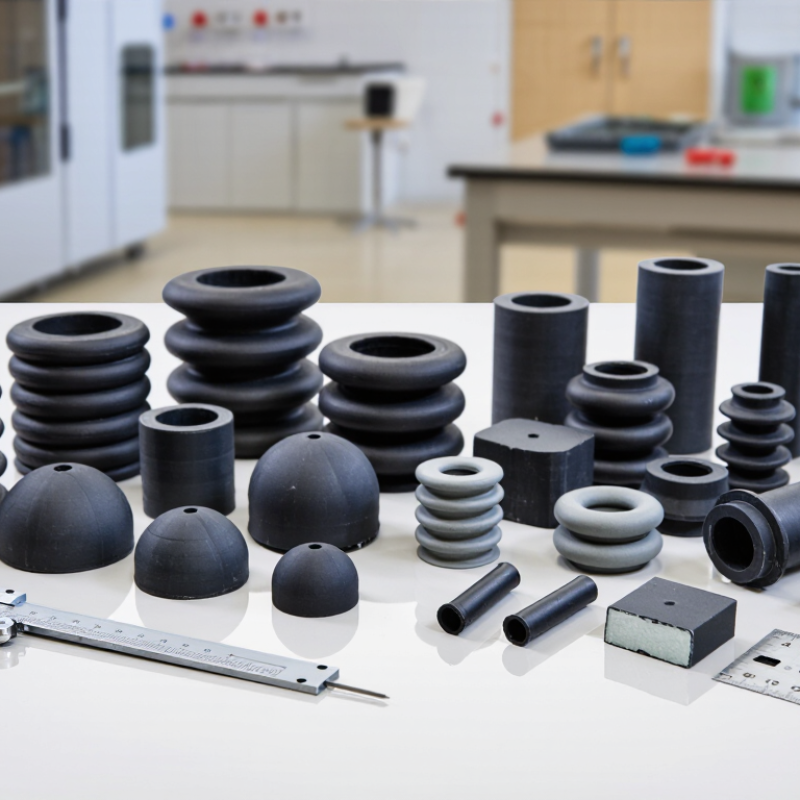
Rubber bumpers differ by shape, hardness, attachment method, and rubber compound. Cylindrical bumpers suit machinery feet and equipment panels. Their flat surfaces spread loads during repeated contact. Conical bumpers provide progressive compression, making them useful for doors, covers, and suspension stops. Hollow bumpers offer softer movement and better energy absorption. They can work well where space is limited.
Rectangular pads and strips protect cabinet doors, glass panels, and furniture surfaces. Their larger contact area reduces sliding and distributes pressure more evenly. Adhesive-backed bumpers simplify installation on clean, smooth surfaces. However, dust, oil, and low temperatures can weaken the bond. Mechanical fasteners remain more dependable under vibration or heavy loads.
Material selection also matters. EPDM handles weather and moisture well, while nitrile rubber suits many oil-contact environments. Silicone performs across wide temperature ranges, but it may tear under sharp, repeated impact. Check hardness, compression set, temperature range, and load capacity before ordering. A bumper that feels firm may still compress too quickly in service. In practical testing, I would measure height loss after repeated loading. This step is often skipped. That is a mistake worth reconsidering. Surface texture, mounting tolerance, and replacement access should also influence the final design.
2026 Best Rubber Bumpers for Global Buyers
How to Choose the Best Rubber Bumpers in 2026
Choosing rubber bumpers starts with the load, not the price. Estimate static force, impact energy, contact area, and deflection. A bumper that feels firm by hand may fail under repeated compression. In field inspections, uneven footprints often reveal poor load distribution. Keep the detail visible.
Material selection matters. The International Rubber Study Group’s 2024 outlook placed global natural-rubber demand near 15.6 million tonnes, showing the scale of material supply and quality variation. Natural rubber suits high resilience and moderate outdoor exposure. EPDM is usually better for ozone, sunlight, and weather. Nitrile is more suitable around oils, but compound data still needs verification. Never select by polymer name alone.
Check Shore A hardness, compression set, temperature range, and rebound behavior. ASTM D395 and ISO 815-1 provide recognized methods for compression-set testing. Ask suppliers for test conditions, not only final values. A result measured at 70°C for 24 hours cannot predict every application. It is only one reference point. Request production samples, then test them with the real bolt torque and surface finish. I still sometimes over-specify hardness; that can increase vibration transfer and noise. A softer bumper may isolate movement better, but excessive deflection can damage nearby parts. Confirm dimensions, tolerances, batch traceability, and material declarations before approving volume orders.
Material, Size, Load, and Environmental Considerations
Selecting rubber bumpers requires more than checking price and appearance. In practical installation work, the material often decides service life.
EPDM performs well outdoors, resisting sunlight, ozone, and rain. Nitrile rubber suits areas exposed to oils and fuels. Silicone tolerates wider temperature changes, but it may offer weaker abrasion resistance. Natural rubber provides strong elasticity, yet aging can accelerate under sunlight.
No material is perfect.
Size affects both stability and compression. Record the bumper’s diameter, height, hole size, and mounting depth. A bumper that is too short may bottom out during impact. One that is too tall may twist or tear. Check the surface. Smooth steel and painted panels can require different fastening methods. Shore hardness also matters. Softer rubber absorbs vibration, while harder rubber supports heavier contact loads.
Load calculations should include static weight, repeated impact, and sideways force. Ask for compression data, not only a maximum load number.
Temperature, humidity, dust, salt air, and chemical exposure can change performance. Buyers should review test methods, batch consistency, dimensional tolerances, and material certificates.
In my experience, small measurement errors create expensive replacements. I have also seen catalog ratings used without considering aging. That shortcut deserves reconsideration.
Select samples, test them under realistic conditions, and inspect them after compression cycles.
2026 Best Rubber Bumpers for Global Buyers
Global purchasing begins with the application, not the lowest quotation. Rubber bumpers may absorb impact, reduce vibration, or protect painted surfaces. Each purpose requires different hardness, compression behavior, and temperature resistance. In my sourcing work, small changes in rubber compound often changed product performance. A bumper tested indoors may fail outdoors under sunlight, moisture, or freezing temperatures. Ask suppliers for material data, hardness results, compression set values, and dimensional tolerances. Recognized quality systems, such as ISO 9001, can support process control, but certification alone cannot prove product fitness. Request recent inspection records and independent test reports when risk is high.
Tips: Compare samples from at least three suppliers. Check odor, surface defects, rebound, and thread accuracy. Test parts after heat, cold, oil exposure, or repeated compression. Keep the same test method for every supplier. This makes comparison fairer. It also reveals weak claims.
Supplier evaluation should include tooling ownership, production capacity, packaging, lead times, and communication speed. A reliable supplier explains limitations instead of promising everything. Ask how rejected parts are identified and how corrective actions are recorded. Factory audits can reveal practical details, such as dusty storage areas or poorly labeled raw materials. Still, audits are only snapshots. I have overlooked minor packaging damage before, and it later caused costly delays. Build inspection points into the purchase agreement, and review performance after each shipment. A perfect checklist does not exist. It should improve with every order.
| Material Type | Typical Hardness | Recommended Service Temperature | Key Performance Characteristics | Best-Fit Applications | Important Limitations | Relevant Test Standards | Global Buyer Evaluation Priority |
|---|---|---|---|---|---|---|---|
| Natural Rubber (NR) | 40–90 Shore A | Approximately −50°C to +80°C | High elasticity, excellent resilience, strong tear resistance, and good vibration absorption. | Anti-vibration mounts, impact stops, machinery feet, and general-purpose cushioning. | Poor resistance to ozone, weathering, oils, and many chemicals unless specially compounded. | ASTM D2240 for hardness; ASTM D412 for tensile properties; ASTM D624 for tear strength; ASTM D395 for compression set. | Suitable when rebound and mechanical toughness are more important than oil or outdoor resistance. |
| SBR | 40–90 Shore A | Approximately −50°C to +100°C | Balanced abrasion resistance, good mechanical strength, and consistent performance for general industrial use. | Machine bumpers, conveyor components, floor stops, and general-purpose rubber pads. | Limited resistance to petroleum oils, fuels, ozone, and prolonged outdoor exposure. | ASTM D2240; ASTM D412; ASTM D395; ASTM D471 for liquid-resistance testing. | Often appropriate for cost-sensitive indoor applications with moderate environmental exposure. |
| EPDM | 40–90 Shore A | Approximately −50°C to +150°C | Excellent resistance to ozone, sunlight, rain, steam, and hot water; good long-term weatherability. | Outdoor bumpers, construction equipment, HVAC components, vehicle sealing parts, and weather-exposed stops. | Unsuitable for most petroleum-based oils and fuels. | ASTM D2240; ASTM D412; ASTM D395; ASTM D1149 for ozone resistance; ASTM D471 for fluid exposure. | Preferred for outdoor durability and weather resistance when oil contact is limited. |
| Nitrile Rubber (NBR) | 40–90 Shore A | Approximately −40°C to +120°C | Good resistance to mineral oils, fuels, hydraulic fluids, and abrasion; useful for sealing and impact-control parts. | Oil-contact machinery, hydraulic equipment, automotive components, and industrial bump stops. | Weak resistance to ozone, sunlight, and weathering unless protected or specially formulated. | ASTM D2240; ASTM D412; ASTM D395; ASTM D471 for oil and fuel resistance. | Strong choice when petroleum-oil compatibility is a primary requirement. |
| Silicone Rubber | 20–90 Shore A | Approximately −60°C to +200°C | Very wide temperature range, excellent weathering, low-temperature flexibility, and good electrical insulation. | High-temperature equipment, electrical enclosures, laboratory devices, appliance parts, and clean environments. | Lower tear and abrasion resistance than many conventional rubber compounds; generally poor resistance to concentrated acids, alkalis, and some solvents. | ASTM D2240; ASTM D412; ASTM D395; ASTM D624; ASTM D471 where fluid exposure is relevant. | Selected when temperature stability, cleanliness, or electrical insulation outweighs abrasion resistance. |
| Polyurethane (PU) | 60 Shore A–95 Shore A | Approximately −30°C to +80°C for many grades | Very high abrasion resistance, high load capacity, strong tear resistance, and low permanent deformation in suitable formulations. | Heavy-duty impact pads, rollers, material-handling equipment, industrial stops, and high-wear applications. | Performance varies significantly by chemistry; some grades are sensitive to high heat, moisture, or hydrolysis. | ASTM D2240; ASTM D412; ASTM D624; ASTM D395; ASTM D471 for fluid compatibility. | Recommended for high-wear and high-load service after confirming temperature and moisture conditions. |
| Neoprene (CR) | 40–90 Shore A | Approximately −40°C to +120°C | Good balance of weathering, ozone, flame resistance, oil resistance, and mechanical strength. | Outdoor industrial equipment, electrical applications, marine components, and general-purpose seals or stops. | Usually more expensive than SBR or NR; not the best choice for prolonged contact with aromatic fuels or strong chemicals. | ASTM D2240; ASTM D412; ASTM D395; ASTM D1149; ASTM D471. | Useful where moderate oil exposure and outdoor durability are both required. |
| Core Quality and Dimensional Data to Request Before Purchase | |||||||
| Dimensional Tolerance | Define length, width, height, diameter, hole position, and flatness tolerances on the approved drawing. | For molded rubber parts, tolerance should be agreed according to part size, tooling design, mold split lines, and the applicable rubber-part tolerance specification. | ISO 3302-1 provides general dimensional tolerance classes for molded, extruded, and calendered rubber products. | Require a dimensioned drawing, inspection plan, and first-article report before mass production. | |||
| Hardness Control | Common commercial target: 60 ± 5 Shore A, unless the application requires a different value. | Hardness must be measured on a flat, representative area using a calibrated durometer; thin sections may produce misleading readings. | ASTM D2240 or ISO 48-4. | Ask for the nominal hardness, tolerance, test method, test location, and calibration records. | |||
| Compression Set | Lower permanent deformation generally indicates better sealing and recovery performance. | The result depends on compound, temperature, test duration, specimen geometry, and compression level; values must be compared only under identical conditions. | ASTM D395 Method B or ISO 815-1. | Specify the test temperature and duration rather than accepting an unspecified “low compression set” claim. | |||
| Tensile and Elongation | Typical industrial rubber compounds may provide approximately 5–25 MPa tensile strength and 150–700% elongation, depending on material and formulation. | These values are comparative indicators and should not replace application-specific validation. | ASTM D412 or ISO 37. | Compare results with the approved compound specification and retain batch-level test records. | |||
| Tear Strength | Higher tear strength is important for parts with thin edges, holes, sharp transitions, or repeated impact. | Test results are influenced by specimen geometry and compound orientation. | ASTM D624 or ISO 34-1. | Use tear testing when the bumper includes slots, mounting holes, lips, or concentrated stress points. | |||
| Chemical Compatibility | Confirm contact with oils, fuels, coolants, cleaning agents, salt water, acids, alkalis, and process chemicals. | Evaluate change in volume, mass, hardness, tensile strength, and appearance after exposure. | ASTM D471 or ISO 1817. | Request immersion data using the actual operating fluid and temperature whenever possible. | |||
| Weather and Ozone Resistance | Critical for outdoor installations, exposed transport equipment, and long-life infrastructure. | Inspect for surface cracking, loss of elasticity, discoloration, and embrittlement after controlled exposure. | ASTM D1149 for ozone resistance; ISO 1431-1 for ozone cracking. | EPDM, neoprene, and silicone are commonly considered before NR, SBR, or unprotected NBR for outdoor service. | |||
| Traceability | Each shipment should be linked to a compound batch, production date, mold or tooling reference, and inspection record. | Traceability supports root-cause analysis, recalls, and repeat-order consistency. | Use an agreed quality plan and documented lot-control procedure. | High priority for safety-related, automotive, infrastructure, and repeat-production programs. | |||
| Packaging and Storage | Store away from direct sunlight, ozone-generating equipment, heat sources, moisture, and chemicals; avoid excessive compression during storage. | Packaging should prevent deformation, contamination, and mixing of different compounds or production lots. | ISO 2230 provides guidance for storage of vulcanized rubber products. | Request packaging specifications, shelf-life guidance, storage conditions, and shipment protection details. | |||
| Supplier Evaluation Checklist for Global Buyers | |||||||
| Technical Capability | Ability to control compound formulation, molding, bonding, trimming, post-curing, and dimensional inspection. | Review equipment capability, laboratory instruments, tooling control, process parameters, and operator training. | Evidence may include process flow charts, control plans, calibration records, and sample inspection reports. | Accept only after technical review and representative sample approval. | |||
| Quality Documentation | Request material specifications, certificates of analysis, inspection reports, nonconformance records, and corrective-action procedures. | Documents should identify the tested lot and match the approved drawing and compound specification. | Use ISO 9001-based quality controls or an equivalent documented system where appropriate. | High priority for consistent global supply and audit readiness. | |||
| Sample and Pilot Validation | Approve samples before production through dimensional, hardness, functional, and environmental testing. | For critical parts, conduct compression, impact, aging, fluid exposure, and installation trials under realistic conditions. | Test methods should be listed in the product specification and purchase agreement. | Do not approve mass production from photographs or untested samples alone. | |||
| Commercial and Logistics Risk | Assess minimum order quantity, tooling ownership, lead time, capacity, export packaging, documentation, and replacement-part support. | Confirm trade terms, destination requirements, labeling, palletization, and inspection responsibilities in writing. | Use a signed purchase specification with acceptance criteria and change-notification requirements. | Balance unit price with total landed cost, quality risk, and supply continuity. | |||