2026 Best Thin-Film Pressure Sensor Options for Precision Measurement?
The demand for precision measurement is driving innovations in sensor technology. Among these, Thin-Film Pressure Sensors stand out for their accuracy and reliability. According to a recent report by MarketsandMarkets, the global market for pressure sensors is expected to reach $14.78 billion by 2026, with a significant portion attributed to Thin-Film technology. This trend highlights the critical role these sensors play in various industries, ranging from healthcare to automotive.
Dr. Emily Chang, a leading expert in sensor technology, emphasizes the importance of Thin-Film Pressure Sensors, stating, "These sensors provide unparalleled precision, which is crucial for applications requiring meticulous measurements." As industries seek to enhance performance and maintain quality standards, the need for reliable and precise measurement tools grows. Thin-Film Pressure Sensors not only meet these requirements but also offer benefits such as compact size and lightweight design.
However, challenges remain in the adoption of new technologies. Cost and integration issues may hinder some industries from transitioning to Thin-Film Pressure Sensors. Organizations must weigh these factors carefully. Addressing these challenges while prioritizing accuracy and performance is essential for future advancements in sensor technology. The coming years will be pivotal for the adoption and evolution of Thin-Film Pressure Sensors.

Overview of Thin-Film Pressure Sensors and Their Applications
Thin-film pressure sensors are essential tools in various industries. These sensors are designed for precise measurement in environments where space and weight constraints exist. They utilize a thin layer of materials to detect pressure changes accurately. The technology behind these sensors has advanced significantly, making them more reliable than ever.
In medical applications, thin-film pressure sensors play a critical role. They are used in devices like ventilators and blood pressure monitors. Their small size allows for the integration into compact systems. However, not all thin-film sensors are created equal. Each application has unique needs, and selecting the right type is vital for optimal performance.
Automotive and aerospace industries also benefit from these sensors. They monitor tire pressure and structural integrity in vehicles. Their ability to withstand harsh conditions is crucial. Yet, these sensors can be sensitive to temperature fluctuations. Users need to assess the environmental factors affecting their performance. The growing demand for more efficient pressure sensors highlights the need for continuous innovation.
Key Features and Advantages of Thin-Film Pressure Sensors
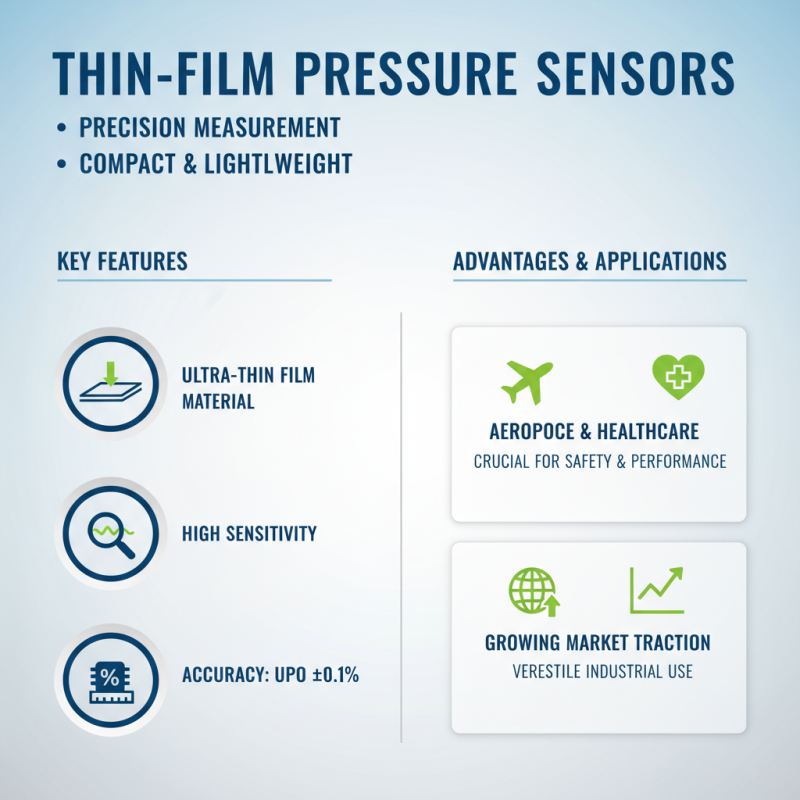
Thin-film pressure sensors are gaining traction in precision measurement applications. Their compact design and lightweight nature make them ideal for various industries. These sensors use a film material that responds to pressure changes, making them highly sensitive. According to a recent market analysis, thin-film sensors offer an accuracy of up to ±0.1%. This level of precision is crucial for sectors like aerospace and healthcare, where exact measurements can impact safety and performance.
The key features of thin-film pressure sensors include rapid response times and durability. These sensors can operate effectively in extreme environments. They typically withstand temperatures ranging from -40°C to 125°C. Additionally, their resistance to shock and vibration increases their reliability in high-stress applications. Despite these advantages, the manufacturing cost can be a challenge. This aspect raises questions about balancing performance with budget constraints for some businesses.
Thin-film pressure sensors also boast excellent linearity. Data from industry reports suggest that linearity often exceeds 98%, enhancing measurement consistency. Nonetheless, variations in sensor performance under different conditions require careful calibration. Users must consider environmental influences on readings. Overall, while thin-film pressure sensors present remarkable benefits, ongoing research is essential to address their limitations.
Top Brands and Models for Precision Measurement in 2026
In 2026, thin-film pressure sensors have gained significant traction in precision measurement across various industries. These sensors offer a compact design and high sensitivity, making them ideal for applications in aerospace, medical devices, and automotive systems. Their lightweight nature allows for seamless integration, even in tight spaces, enhancing overall system performance.
Leading manufacturers focus on robustness and accuracy. Some models feature advanced materials that improve stability and reliability. These enhancements contribute to more consistent readings and durability under varying environmental conditions. Users may, however, encounter variations in performance based on the application. It’s essential to assess sensor specifications carefully.
Despite their advantages, challenges remain in selecting the right model. Calibration processes can fluctuate, affecting measurement precision. Therefore, thorough testing and validation are crucial before deployment. Users should also consider long-term maintenance, as sensor behavior can change over time. Being proactive in these areas can significantly improve measurement outcomes.
Comparison of Performance Metrics for Leading Thin-Film Sensors
In the realm of precision measurement, thin-film pressure sensors are gaining traction. Their design allows for highly accurate readings, crucial in many industries. A key performance metric is sensitivity, which dictates how responsive a sensor is to pressure changes. Higher sensitivity often means more precise measurements, but it may also lead to more noise in the data. This trade-off requires careful evaluation.
Another important factor is stability over time. Sensors must maintain accuracy despite environmental changes like temperature and humidity. Testing methods for long-term stability vary, and some options may be more reliable than others. It's not uncommon for sensors to exhibit drift, reducing their effectiveness in critical applications.
Furthermore, response time remains a critical metric. Sensors that react quickly to pressure fluctuations are essential in dynamic settings. However, faster response may compromise robustness. Exploring these nuances is essential for selecting the right sensor for specific applications. Identifying the balance between sensitivity, stability, and response time requires deeper analysis and reflection.
Performance Comparison of Leading Thin-Film Pressure Sensors (2026)
This chart illustrates the performance metrics of various thin-film pressure sensors available in 2026, including sensitivity, linearity, and response time. These metrics are crucial for evaluating the precision and reliability of these sensors in various measurement applications.
Future Trends and Innovations in Thin-Film Pressure Sensing Technology
The field of thin-film pressure sensing technology is undergoing significant advancements, driven by the demand for precision measurement in various applications. According to a recent market analysis published by industry experts, the global thin-film pressure sensor market is expected to reach $2.4 billion by 2026, growing at a CAGR of 8.5%. This growth indicates a rising need for reliable and accurate pressure measurement tools across industries such as automotive, healthcare, and aerospace.
Innovations in materials, such as the development of nanomaterials, play a pivotal role in enhancing sensor performance. For instance, research shows that using graphene-based materials can significantly improve sensitivity and response time. These materials are not only lightweight but also exhibit remarkable durability under extreme conditions. However, challenges remain in scalability and production costs, which may hinder widespread adoption.
Moreover, integrating thin-film sensors with Internet of Things (IoT) technology opens new avenues for data analytics in pressure sensing. This integration allows for real-time monitoring and predictive maintenance, leading to improved operational efficiencies. Yet, ensuring data integrity and security remains a critical concern. As the technology evolves, it is essential for industries to address these complexities to fully harness the potential of thin-film pressure sensors.
2026 Best Thin-Film Pressure Sensor Options for Precision Measurement
| Sensor Type |
Measuring Range (psi) |
Sensitivity (mV/psi) |
Temperature Range (°C) |
Response Time (ms) |
| Standard Thin-Film |
0-100 |
10 |
-40 to 85 |
1 |
| High-Accuracy Thin-Film |
0-500 |
5 |
-40 to 125 |
2 |
| Miniature Thin-Film |
0-50 |
15 |
-20 to 85 |
3 |
| Ultra-Low Pressure Thin-Film |
0-10 |
25 |
-40 to 70 |
5 |
| High-Temperature Thin-Film |
0-300 |
8 |
-40 to 200 |
3 |