Leave Your Message

2026 Best Silicone Rubber Gasket Types for Global Buyers?

Silicone rubber gaskets are becoming essential across food processing, medical equipment, electronics, automotive systems, and clean-energy applications. Their flexibility, low compression set, and resistance to temperature extremes support reliable sealing in demanding environments. Grand View Research and MarketsandMarkets both identify silicone elastomers as a growing material category, driven by healthcare, mobility, and advanced manufacturing demand. These reports indicate opportunity, but not automatic suitability.

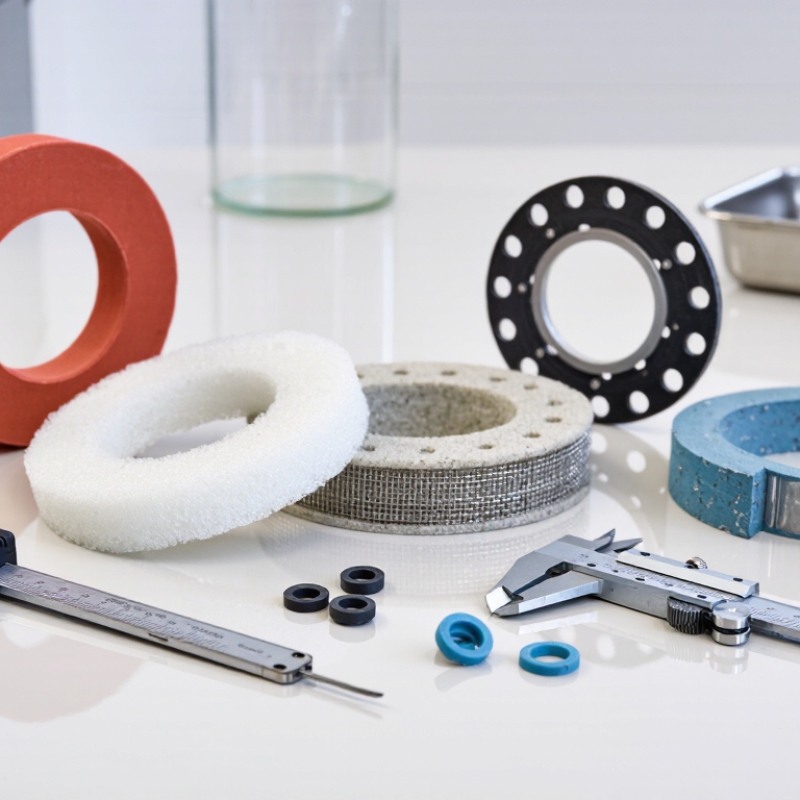
The best choice depends on more than market growth. A buyer must compare solid silicone, sponge silicone, foam silicone, reinforced silicone, and metal-detectable grades. Shore hardness matters. So does the sealing profile. A soft gasket may conform around a rough flange, while a firmer grade can perform better under repeated compression. Temperature, pressure, chemicals, sterilization cycles, and installation method should guide the decision. Rubber Gasket Silicone products may appear similar, yet their performance can differ significantly between suppliers.

Standards provide useful evidence. ASTM D2000 helps classify elastomer performance, while ISO 3601 is relevant when the product uses an O-ring design. Food-contact and medical applications may also require documented compliance with applicable regional regulations. Certificates alone are not enough. Traceability matters.

A practical inspection should include hardness testing, dimensional checks, visual examination, and compression-set data. Ask for batch records. Check the actual compound.

This guide compares the leading silicone gasket types for global buyers in 2026. It also examines supplier documentation, customization, lifecycle cost, and common purchasing mistakes. Forecasts can be persuasive, but field conditions remain decisive. No single gasket wins every application.
2026 Best Silicone Rubber Gasket Types for Global Buyers?

Silicone Gasket Fundamentals: VMQ, PVMQ, and FVMQ Material Classes

For global buyers, silicone gasket selection starts with three material classes: VMQ, PVMQ, and FVMQ. Their differences matter at the sealing line.

VMQ is the general-purpose choice for hot air, water, steam, and outdoor exposure. It remains flexible across roughly -60°C to 200°C, depending on formulation and compression.

PVMQ adds phenyl groups, improving low-temperature flexibility and thermal cycling performance. It suits cold climates, aerospace-style environments, and seals exposed to sudden temperature changes.

FVMQ contains fluorinated chemistry. It offers stronger resistance to fuels, oils, and hydrocarbon vapors, although its mechanical strength can be lower than some VMQ compounds.

The numbers support careful material planning. A 2024 Grand View Research report estimated the global silicone elastomers market at more than USD 8 billion, with continued growth through 2030. Demand is rising in automotive, electronics, medical equipment, and energy systems. However, market growth does not remove application risks. ASTM D2000 classification helps compare rubber performance, while ISO 3601 is commonly used for O-ring dimensions and tolerances. Neither standard replaces real media testing. A gasket that survives 180°C air may swell quickly in fuel. This is where buyers often underestimate compound selection.

Check compression set, hardness, tear strength, and surface finish. Request batch certificates and test results. Small details matter. One overlooked flange gap can defeat an excellent silicone compound. Some specifications remain incomplete, especially when buyers provide temperature but not pressure, fluid concentration, or cycling frequency. That weakness deserves review before production approval.

Temperature Selection: Typical −60 to 200°C Service and Compression Set

2026 Best Silicone Rubber Gasket Types for Global Buyers?

Temperature selection starts with the real service range, not a catalogue headline. Silicone rubber commonly supports service from about −60 to 200°C. Actual limits depend on compound design, exposure time, pressure, and gasket geometry. At −60°C, the material becomes stiffer and may seal poorly during movement. At 200°C, long exposure can increase hardness, shrinkage, and compression set.

Compression set deserves careful attention. It measures how much sealing force the gasket fails to recover after compression and heat. A gasket with high compression set may leak after months of thermal cycling. Thin flanges, uneven bolts, and oversized grooves can worsen this result. Small details matter. I have seen good material fail because installation pressure was inconsistent.

Global buyers should request test data at the intended temperature, not only room-temperature figures. ASTM D395 results can support comparison, but they cannot replace application testing. Check hardness, tensile retention, dimensional change, and recovery after repeated heating. For outdoor equipment, include moisture, ozone, and ultraviolet exposure. For low-temperature systems, test the first cold start. For high-temperature systems, inspect the gasket after extended compression. Perfect ratings are not enough. A practical mistake is choosing the widest temperature range instead of the correct compression design. Temperature peaks, daily cycling, and maintenance intervals should shape the final selection.

Gasket Type Guide: O-Rings, Flat, Tri-Clamp, and Custom-Molded Designs

Selecting the right silicone gasket starts with the joint, temperature, pressure, and cleaning method. O-rings suit compact, repeatable sealing grooves. Flat gaskets work well across flanges with broader contact surfaces. Tri-Clamp gaskets support hygienic connections and faster maintenance. Custom-molded designs solve unusual shapes, thin walls, or uneven loading. They cost more initially, but can reduce leakage and assembly errors. No single gasket wins every line.

Grand View Research estimated the global silicone elastomers market at about USD 8.6 billion in 2023, with continued growth through 2030. That expansion reflects demand from food equipment, medical devices, electronics, and industrial processing. For buyers, material selection should not rely on appearance alone. Request compound identification, hardness, compression-set results, and dimensional inspection records. ASTM D395 helps evaluate compression set, while ISO 3601 supports O-ring dimensional control. These references improve supplier comparisons, although they do not replace application testing.

In practical trials, a Tri-Clamp gasket may seal well but deform after repeated hot cleaning. A flat gasket may appear economical yet require higher bolt-load control. Custom molding can fix that problem, but tooling changes are easy to underestimate. I would test the actual mating surfaces, cleaning cycle, and installation method before approving volume production. Small details matter.

Compliance Benchmarks: FDA 21 CFR 177.2600, EU 1935/2004, and USP Class VI

2026 Best Silicone Rubber Gasket Types for Global Buyers?

Silicone rubber gaskets suit food equipment, laboratory devices, and many sanitary sealing applications. Solid silicone works well for stable compression and repeated cleaning. Sponge silicone helps fill uneven gaps with lower closing force. Fluorosilicone may resist fuels and oils, but it needs separate compatibility testing. Gasket type alone does not prove compliance.

For food-contact applications, review FDA 21 CFR 177.2600 test results and extraction conditions. The document should match the rubber formulation, curing method, and intended use. EU 1935/2004 requires materials to avoid harmful migration and unacceptable taste or odor. Ask for a declaration of compliance, supporting migration data, and production traceability. USP Class VI testing evaluates biological response for relevant medical-use conditions. It does not automatically confirm chemical compatibility or sterilization performance. A certificate can look convincing, yet the evidence may cover another compound.

Tips: Confirm temperature, pressure, media, and cleaning chemicals before approval. Request lot-specific records when risk is high. Check dimensions after compression. Inspect a sample under bright light for cuts, bubbles, or incomplete curing. Keep the test report and drawing together. This simple habit prevents costly confusion. Some buyers treat FDA or USP language as a universal approval. That assumption needs review. Compliance depends on the finished article, its use, and verified test scope.

2026 Best Silicone Rubber Gasket Types for Global Buyers

The chart compares commonly specified silicone gasket constructions by typical continuous service-temperature upper limit. Final suitability depends on formulation, curing method, pressure, media, cleaning cycle, and test documentation.

Compliance benchmarks: FDA 21 CFR 177.2600 addresses rubber articles intended for repeated food-contact use; EU Regulation (EC) No 1935/2004 requires materials not to endanger health or adversely affect food; USP Class VI evaluates biocompatibility for specified pharmaceutical and medical-contact applications. Compliance is application- and formulation-specific and should be supported by supplier declarations and test reports.

Global Buying Specifications: ASTM D1418, ISO 3601, Shore A, and Tolerances

2026 Best Silicone Rubber Gasket Types for Global Buyers?

For global purchasing, material language must be precise. ASTM D1418 identifies silicone rubber as VMQ. It does not define every gasket dimension or performance requirement. Buyers should confirm the compound, curing method, temperature range, and application conditions separately. A 70 Shore A gasket may suit a rigid flange, but softer material can seal uneven surfaces more effectively.

ISO 3601 mainly covers O-rings, including sizes, tolerances, and inspection practices. It should not be applied automatically to every silicone gasket. Ask suppliers to state the exact standard edition and product scope. Check groove dimensions, cross-section, inside diameter, and flash limits against the technical drawing. Small errors matter. A 0.2-millimeter mismatch can create leakage after assembly.

In practical sourcing, request Shore A test results from the same production lot. Hardness readings can vary across thin sections and curved areas. Confirm the testing method and sampling location. Also request dimensional inspection records, certificates of conformity, and traceability details. I have seen specifications that looked complete but omitted tolerance classes. That gap deserves attention. A clear purchase specification should define material grade, hardness range, dimensional tolerances, visual defects, packaging, and inspection responsibility before production starts.

2026 Best Silicone Rubber Gasket Types for Global Buyers? — Global Buying Specifications: ASTM D1418, ISO 3601, Shore A, and Tolerances
Gasket Type ASTM D1418 Material Designation Typical Temperature Range Recommended Shore A Typical Applications Relevant Global Specification Dimensional and Tolerance Guidance Buyer Selection Priority
General-Purpose Silicone Flat Gasket VMQ -50 to +200 °C
Short-term exposure may be higher depending on compound and design.
50–70 Static flanges, covers, inspection doors, low-pressure seals, and general industrial equipment. ASTM D1418 for rubber nomenclature; ASTM D2000 may be used when a purchaser specifies a complete rubber classification. Use the drawing or purchase specification for thickness, inside diameter, outside diameter, and flatness. Do not substitute ISO 3601 unless the part is an O-ring. Low compression set, surface finish, and stable thickness.
Silicone O-Ring VMQ -50 to +200 °C 70–80 Static axial or radial sealing, instrumentation, valves, pumps, and low-temperature applications. ISO 3601-1 for O-ring dimensions; ISO 3601-3 for quality, defects, and surface imperfections. Specify the ISO 3601 size designation, cross-section, inside diameter, application class, and tolerance class. Class A is generally used for aerospace applications; Class B is generally used for general applications. Correct groove design, compression, stretch, and resistance to the service fluid.
High-Consistency Silicone Cord Gasket VMQ -60 to +200 °C 50–80 Large access covers, oven doors, cabinets, ducting, and custom-length seals. ASTM D1418 for material designation; dimensional requirements should be stated on the drawing or purchase specification. Cord diameter is commonly selected from standard sizes, but the finished joint, cut length, joint gap, and diameter tolerance must be agreed in the drawing. Bonded joints require separate acceptance criteria. Consistent cord diameter, clean joint, and controlled compression.
Sponge Silicone Gasket VMQ -60 to +200 °C Typically 10–40 apparent hardness Enclosures, doors, panels, HVAC equipment, and applications requiring high conformability. ASTM D1418 identifies the rubber family; ASTM D1056 is commonly referenced for cellular rubber and sponge material classification when applicable. Specify density or grade, thickness, width, compression-deflection behavior, cell structure, and dimensional tolerances. Solid-rubber Shore A values should not be used to describe sponge hardness without qualification. Compression recovery, sealing pressure, cell uniformity, and environmental resistance.
Fluorosilicone Gasket FVMQ -60 to +175 °C 60–80 Fuel, oil, solvent, and hydrocarbon exposure where standard VMQ has insufficient fluid resistance. ASTM D1418 for FVMQ designation; ASTM D2000 may be used for a detailed compound and property callout. Use the product drawing for non-circular gaskets. For O-rings, ISO 3601 dimensional requirements may apply. Confirm tolerance class, cross-section, and inside diameter separately from the material designation. Fluid compatibility, compression set, temperature range, and permeation control.
Platinum-Cured Silicone Gasket VMQ -50 to +200 °C 30–80 Food-contact equipment, pharmaceutical processing, laboratory equipment, and clean manufacturing environments. ASTM D1418 for material family; food-contact or hygienic compliance must be specified separately according to the destination market. Define flash, burrs, parting lines, surface finish, extractables, cleanliness, and dimensional tolerances. ISO 3601 applies only when the product is an O-ring. Cleanliness, extractables, traceability, and controlled post-curing where required.
Conductive Silicone Gasket VMQ -50 to +150 °C
Actual limits depend on conductive filler and compound.
50–80 EMI shielding, electrical enclosures, communication equipment, and grounding interfaces. ASTM D1418 for silicone rubber designation; electrical resistance, shielding effectiveness, and environmental tests must be specified separately. Specify profile dimensions, compression range, resistance or shielding target, surface contact requirements, and allowable dimensional variation on the drawing. Electrical performance, compression stability, contact pressure, and oxidation resistance.
Metal-Detectable Silicone Gasket VMQ -50 to +200 °C 50–80 Food-processing lines, packaging machinery, and production areas requiring foreign-material detection. ASTM D1418 for material designation; detection capability and food-contact requirements must be stated independently. Specify profile, thickness, compression, detectable-particle performance, color requirement, and permissible flash. ISO 3601 is relevant only for an O-ring configuration. Detectability, hygienic design, cleanability, and resistance to cleaning chemicals.
Custom Molded Silicone Frame Gasket VMQ or FVMQ -50 to +200 °C for VMQ
-60 to +175 °C for FVMQ
50–80 Electronic housings, control panels, lighting systems, battery enclosures, and formed sealing frames. ASTM D1418 for material designation; drawing-based dimensional control is normally required. Control length, corner geometry, hole position, section dimensions, flash, and warpage. Use ISO 3601 only if the sealing element is manufactured as an O-ring. Corner integrity, assembly fit, compression uniformity, and repeatable molding quality.
Silicone Lip or Wiper Seal VMQ -50 to +200 °C 50–75 Dust covers, splash protection, sliding panels, low-speed shafts, and protective closures. ASTM D1418 for material designation; profile and functional requirements should be controlled by a technical drawing. Specify lip height, sealing edge thickness, interference, concentricity, and permissible flash. ISO 3601 does not define general lip-seal profiles. Low friction, tear resistance, lip geometry, and dimensional repeatability.
Compression-Molded Silicone Gasket VMQ or FVMQ -50 to +200 °C for VMQ
-60 to +175 °C for FVMQ
40–80 Flange seals, covers, manifolds, appliance assemblies, and low-to-medium pressure static sealing. ASTM D1418 for rubber nomenclature; ASTM D2000 may be used when compound performance requirements are defined. Specify thickness, profile, parting-line location, flash limits, flatness, hole position, and general dimensional tolerances on the drawing. Compression set, mold-filling quality, flash control, and dimensional stability.
Liquid Silicone Rubber Formed Gasket VMQ -50 to +200 °C 20–80 Small precision seals, overmolded components, connectors, sensors, and automated assembly. ASTM D1418 for material designation; part-specific drawing controls geometry and dimensional requirements. Define bead height and width, flash, gate vestige, mold alignment, positional tolerance, and substrate adhesion. ISO 3601 does not apply unless the finished part is an O-ring. Bead consistency, adhesion, flash control, and automated inspection capability.