Leave Your Message

How to Choose Nitrile O Rings for Your Application in 2026?

Choosing Nitrile O Rings in 2026 starts with the conditions they must survive, not the product label alone. Nitrile rubber, also called NBR, is widely used for seals exposed to oils and fuels. Yet one formulation will not suit every machine. A seal beside a warm hydraulic line faces different demands from one inside a fuel pump or a washdown unit.

Check the fluid, temperature range, pressure, and movement at the sealing point. Then confirm the O-ring’s dimensions and hardness against the gland design. A ring that looks correct on a workbench can still leak if it is stretched too far, squeezed unevenly, or exposed to a fluid that attacks its compound. Small details matter: a nick on the sealing surface or a sharp groove edge may cause trouble before the equipment reaches full load.

Treat material selection as a practical engineering decision. Review the supplier’s compatibility data, verify operating limits, and test the chosen compound under realistic conditions when failure would be costly. Nitrile O Rings offer useful performance in many applications, but they are not a universal answer. One limitation is easy to overlook: “NBR” covers multiple compounds, and their properties can vary. No verified article or source quotation was provided, so I can’t responsibly attribute a sentence to a named industry expert.
How to Choose Nitrile O Rings for Your Application in 2026?

Identify the Application’s Pressure, Temperature, and Motion Requirements

Before choosing a nitrile O-ring, record the actual pressure range, including startup spikes, not just the steady operating value. Pressure can force an elastomer into the clearance gap, so groove dimensions, hardness, and backup-ring needs matter alongside the seal material. ISO 3601-2:2016 provides housing-dimension guidance, while ASTM D2000-18 classifies rubber compounds by properties such as heat and oil resistance. Neither standard replaces checking the selected compound’s technical data sheet. A few bar may be manageable in one well-supported gland and problematic in another.

Temperature and motion change the decision. As a preliminary screening range, many NBR compounds are rated near -30°C to +100°C, but formulation and exposure time can shift those limits. Confirm the supplier’s continuous and intermittent ratings, especially near hot oil, cold starts, or repeated washdowns. For motion, distinguish static sealing from reciprocating or rotary service: sliding contact generates heat and wear, while shaft speed, surface finish, and lubrication influence seal life. A slow-moving piston is not automatically gentle. I would note peak temperature and motion cycles during real operation; field conditions are often less tidy than the drawing suggests.

Match Nitrile Rubber Grades to Fluids and Chemical Exposure

Choosing a nitrile O-ring starts with the fluid, not the seal color or a generic “oil-resistant” label. Check the exact chemical, its concentration, temperature, and exposure time. Mineral oils and many hydraulic fluids are often suitable for nitrile, but additives can change compatibility. Test the real fluid when the formulation is unfamiliar.

Nitrile grades differ in acrylonitrile content. Higher content generally improves resistance to oils and fuels, but can reduce flexibility at low temperatures. Lower-content grades may stay more flexible in the cold, yet swell more in some oils. A small test seal can reveal changes in size, hardness, or surface feel after soaking. Look closely.

Chemical names alone are not enough. Aromatic solvents, ketones, and some chlorinated chemicals can be unsuitable for many nitrile compounds; verify against a compatibility chart for the specific grade. Heat and pressure matter too. A seal exposed to warm fluid may behave differently from one used at room temperature. That sounds neat on paper; real installations are less tidy. Check the compound’s service limits and test under operating conditions before specifying it.

How to Choose Nitrile O-Rings in 2026: Match NBR Grades to Fluids

Typical NBR compatibility ratings are a screening guide, not a guarantee. Higher scores indicate generally better compatibility; actual performance depends on the specific compound, temperature, concentration, and exposure time.

Selection tip: Higher-acrylonitrile NBR grades generally improve resistance to oils and fuels, but reduce low-temperature flexibility. Aromatic hydrocarbons, ketones, and ozone are generally poor fits for standard NBR; check the exact compound’s compatibility data before specifying an O-ring.

Choose O-Ring Size, Cross-Section, and Installation Fit

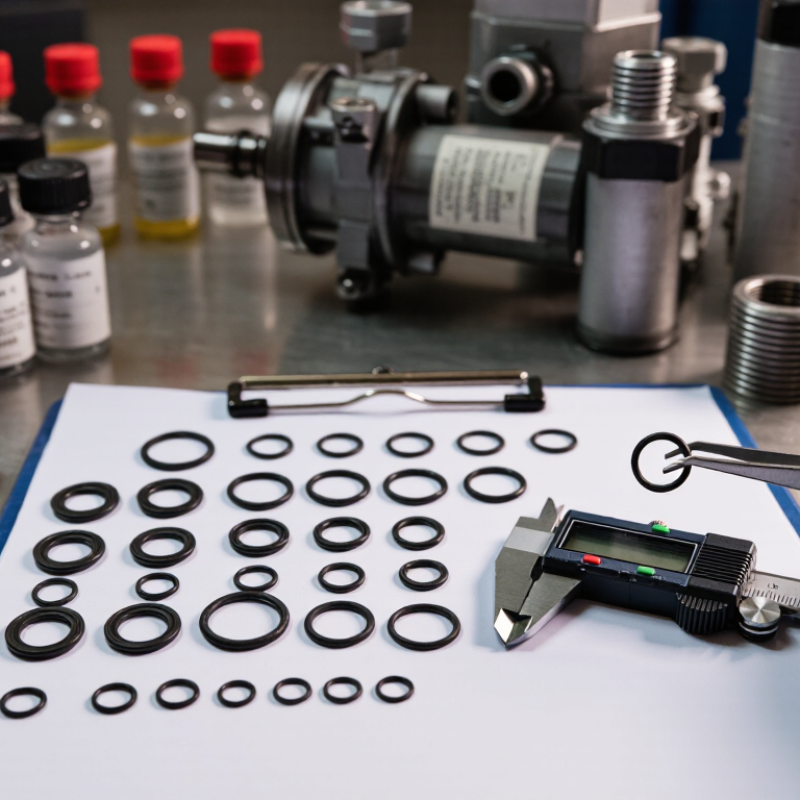
Choosing a nitrile O-ring begins with the groove, not the seal bag. Measure the shaft or bore and the gland dimensions with clean calipers. A worn groove can make a correct drawing misleading. Check the actual hardware.

For a shaft seal, account for the ring’s stretch when selecting its inside diameter. For a bore seal, check how the ring sits around the plug or piston. Do not assume a familiar nominal size will fit every groove. Small differences matter. Cross-section determines how much the seal is compressed and how much space it occupies. Too little squeeze may allow leakage; too much can cause rapid wear or difficult assembly. Check tolerances carefully, including the groove width and depth.

Installation fit deserves the same attention as sizing. The groove should hold the ring without pinching it, and sharp edges should be eased or covered during assembly. Use a lubricant compatible with both the nitrile compound and the service fluid. Avoid twisting. After assembly, look for cuts, spirals, or sections that have rolled out of position. This inspection takes seconds. Also confirm the selected nitrile grade suits the application’s fluids and temperatures; “nitrile” alone does not define every compound’s limits. A drawing helps, but it cannot show every burr or worn surface. Some assumptions need checking.

Check Operating Limits, Wear Risks, and Service Life

A nitrile O ring should be selected against the actual fluid, temperature, pressure, and movement in your equipment. Check the compound’s published operating limits rather than relying on a generic temperature range. Oil compatibility matters, but additives and cleaning fluids can change the result. Heat changes everything. Sustained high temperatures may harden the elastomer and reduce its ability to seal; cold conditions can make it less flexible. Confirm limits with the supplier’s technical data and test the seal in the intended fluid when failure would be costly.

Wear risks depend on how the seal moves and how it is installed. A dynamic O ring sliding along a rough shaft may abrade quickly, while sharp edges can nick a ring during fitting. Excessive pressure can push the material into a clearance gap, causing extrusion and damage. Check groove dimensions, surface finish, lubrication, and pressure peaks—not just normal running conditions. Small details matter. A tiny twist during installation can create a leak path.

Service life is also shaped by compression set, chemical exposure, heat cycling, and maintenance intervals. Inspect removed seals for flattening, cracks, swelling, or polished wear marks; each can point to a different cause. Replacing rings on a fixed schedule may help, but the right interval depends on actual duty and inspection findings. A specification can look perfect on paper and still miss a real-world variable. Keep notes on operating conditions and failures, then revise the selection when evidence calls for it.

Verify Material Certification and Supplier Quality in 2026

In 2026, a nitrile O-ring certificate should identify the exact compound, not just say “NBR.” Request a lot-specific certificate of analysis showing hardness, tensile strength, elongation, and cure date. ASTM D2000 provides a coded system for specifying rubber properties; compare the supplier’s callout with your drawing and test requirements. A generic material sheet is not enough. Check the lot.

Supplier quality needs evidence beyond a quality-system certificate. Ask for traceability from compound batch to shipped parts, documented inspection results, and change-control procedures. ISO 3601-1 covers O-ring dimensions and tolerances, so verify actual dimensions against the specified size and class. Industry O-ring engineering handbooks commonly place general-purpose nitrile service near -40°C to 121°C, but compound, fluid, pressure, and exposure time can shift that range. Confirm compatibility using the exact formulation. I would not treat a neat certificate as proof of field performance; that assumption is easy to make. Keep a retained sample and compare incoming measurements across lots, especially when seals face heat, oil, or repeated compression.