Choosing the right Flat Rubber Ring is more than matching an inside diameter to a drawing. A ring may look suitable on a clean workbench, yet fail after exposure to heat, oil, pressure, or repeated compression. Practical selection begins with the application, not the catalog photograph. Identify the sealing surface, groove dimensions, operating temperature, fluid contact, pressure range, and movement before comparing materials. Small details matter. A sharp groove edge can cut rubber during installation.
These seven tips bring technical judgment into a purchasing decision. They cover material compatibility, hardness, dimensions, compression, temperature resistance, surface quality, and supplier reliability. EPDM, NBR, silicone, and fluorocarbon compounds behave differently, so the cheapest option is rarely the safest assumption. Check technical data sheets, production tolerances, batch traceability, and recommended storage conditions. Reliable manufacturers should explain test methods and provide consistent documentation. That evidence supports a more defensible choice.
There is no universal best ring.
Even experienced maintenance teams can overlook installation pressure or long-term compression set. I have seen a ring pass a visual inspection and still leak because its groove was slightly oversized. That kind of mistake is easy to repeat when measurements are rushed. Recheck the dimensions with calibrated tools, confirm the actual service conditions, and consider a small trial installation. The process is not perfectly linear. Field feedback may reveal that the original material, hardness, or size needs revision before full production.
7 Tips for Choosing the Right Flat Rubber Ring
Tip 1: Define the service conditions before comparing rubber materials. Record pressure, temperature, media, and operating time. Static sealing differs from repeated movement. Pressure spikes matter too. A ring exposed to 8 MPa continuously may face 12 MPa during startup. Check the extrusion gap, sealing geometry, and surface finish before choosing hardness.
Tip 2: Measure temperature at the sealing point, not only in the surrounding room. Heat can rise near pumps, valves, or metal flanges. Include cold starts, cleaning cycles, and short-term peaks. Then check whether the rubber keeps its elasticity across that range. My early estimates have sometimes missed brief temperature surges. That mistake can shorten service life.
Tip 3: Identify every contacting medium, including oils, water, fuels, cleaning agents, and process chemicals. Compatibility charts are useful, but they are not final proof. Swelling, softening, cracking, and weight change should be checked with a sample test. Observe the ring after exposure. Small changes matter.
Tip 4: Specify dimensions and tolerances using ISO 3302-1 where applicable. Confirm inner diameter, outer diameter, thickness, and permissible variation. Do not treat a nominal size as an exact size. Groove dimensions and compression also control performance. Ask for inspection records when the seal is safety-critical. A trial fit may reveal problems that drawings hide.
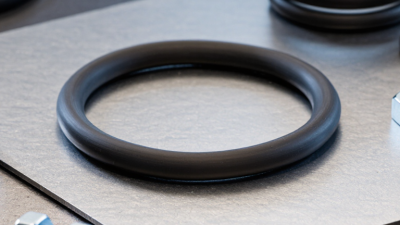
7 Tips for Choosing the Right Flat Rubber Ring
Check the working temperature before comparing rubber compounds. NBR commonly handles about -40 to 108°C, while EPDM may cover -54 to 150°C. These figures are useful guides, not guarantees. Continuous heat, pressure, and exposure time can reduce service life. Check the fluid. NBR usually suits mineral oils, fuels, and many hydraulic fluids. EPDM generally performs better with hot water, steam, ozone, and weather exposure. Never select EPDM for petroleum-based fluids without verified compatibility data.
Measure the groove carefully. A ring that is too thick may create excessive compression and friction. A loose fit may leak during vibration or pressure changes. Inspect the mating surfaces for scratches, burrs, and sharp edges. Small defects can cut the sealing edge. Consider temperature cycling, not only the highest reading. An assembly moving between -30°C and 120°C may age differently from one staying at 90°C. That detail is easy to miss.
Review compression set data at the real operating temperature. A compound can appear suitable on a chart but fail after repeated heating. Confirm hardness, pressure, fluid concentration, and installation stretch with the supplier’s technical documentation. Avoid mixing old and new rings in critical maintenance work. Record the compound and dimensions during inspection. A clean installation matters, too. Many failures begin with contamination, not poor rubber. I have seen neat-looking seals selected from incomplete data; the decision seemed reasonable, but the missing fluid details changed everything.
A flat rubber ring must match the joint, not just the drawing. Hardness affects sealing force, flexibility, and resistance to extrusion. Around 70 Shore A is a practical baseline for many static sealing applications. It usually balances easy compression with enough support under moderate pressure. However, “standard” does not mean universally correct. A softer ring may seal rough surfaces better, while a harder compound may resist gap movement more effectively.
Tip: Check the compression ratio before ordering.
Measure the ring’s cross-section, groove depth, and mating surfaces. Many designs aim for controlled compression rather than maximum squeeze. Excessive compression can increase installation force and accelerate permanent deformation. Too little compression may allow leakage after vibration or temperature changes. I have seen seals pass a bench test but fail after repeated assembly. That detail is easy to overlook. Shore hardness also changes with temperature, aging, and measurement method, so supplier data should be verified against actual conditions.
Tip: Test the complete assembly.
Use representative pressure, temperature, fluid exposure, and installation tools. Inspect compression set after cycling, not only immediately after assembly. A small tolerance review can reveal more than a polished specification sheet. If the joint has a wide clearance gap, consider a harder material or an anti-extrusion design. If the surface is delicate, reduce sealing stress carefully. Record failures honestly; the first selection is sometimes only a useful starting point.
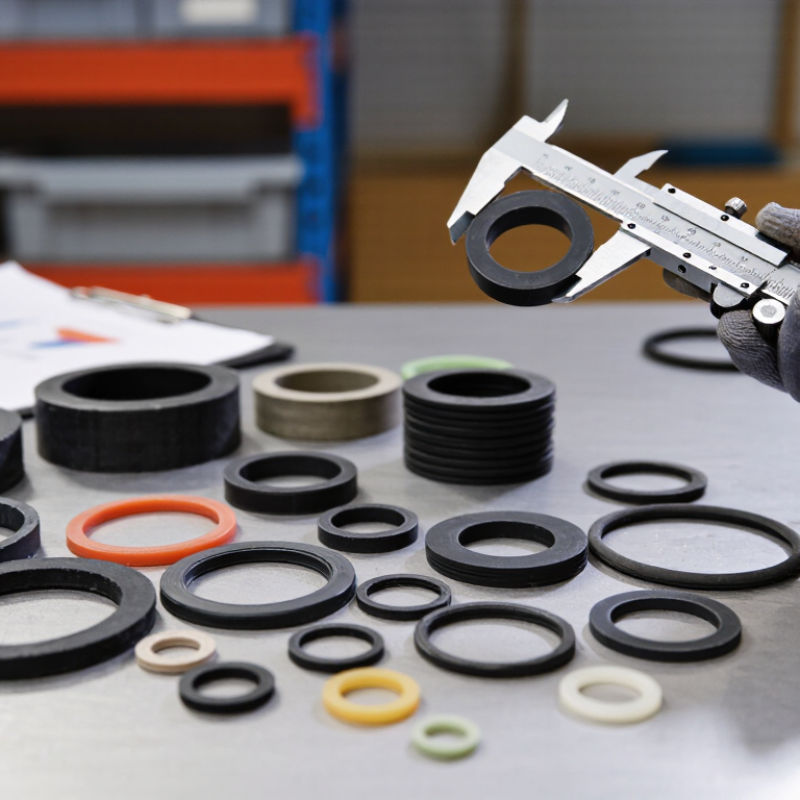
Choosing a flat rubber ring starts with the groove, not the catalog. Measure the inner diameter, outer diameter, and cross-section with calibrated tools. Compare those measurements with AS568 when the ring uses an inch-based profile. AS568 standardizes dimensions, but it does not verify rubber quality. Check clearance, squeeze, and installation stretch. A ring can fit and still fail.
Use ASTM D412 data to evaluate tensile strength and elongation. These values show how rubber responds when pulled, not how it seals under compression. Request the specimen type, test temperature, cure condition, and test direction. Small details matter. Compare results from the same test conditions. I have seen a strong-looking datasheet hide poor elongation in cold service. That assumption needed correction. Do not guess.
Review ASTM D395 compression set results for long-term sealing performance. Lower compression set generally indicates better recovery after sustained compression. However, the method, temperature, and exposure time affect the result. Match the reported method to your operating conditions. Then check hardness, fluid exposure, temperature, and pressure separately. Do not select by strength alone. Keep a sample ring for trial fitting and cycling. Inspect it afterward for cuts, flattening, uneven squeeze, or groove damage. Record every change. This practical evidence can expose problems that laboratory values miss.
| No. | Selection Tip | What to Verify | Reference Standard | Example Data | Recommended Check |
|---|---|---|---|---|---|
| 1 | Match the nominal size | Confirm the ring’s inside diameter (ID), cross-section (CS), and outside diameter (OD). For a circular section: OD ≈ ID + 2 × CS. | AS568 dash-size designation |
Example size: AS568-214 ID: 0.734 in (18.64 mm) CS: 0.139 in (3.53 mm) OD: 1.012 in (25.70 mm) |
Measure multiple samples with calibrated equipment and compare with the applicable AS568 dimensional tolerances. |
| 2 | Allow for installation stretch | Excessive stretch can reduce cross-section and sealing force. Check the installed ID against the groove or shaft dimensions. | AS568 size selection; application-specific design practice |
Free-state ID: 18.64 mm Example installed ID: 19.20 mm Approximate stretch: 3.0% |
Use the actual groove geometry, allowable stretch, squeeze, and ring diameter before approving the size. |
| 3 | Check material hardness | Hardness affects installation force, sealing behavior, and resistance to extrusion. Select a hardness suitable for the pressure and gap. | ASTM D2240 for Shore hardness | Example specification: 70 ± 5 Shore A | Test conditioned specimens using the appropriate Shore durometer scale and report the measured average. |
| 4 | Verify tensile strength | Tensile strength indicates the stress required to break a test specimen. It is useful for comparing material batches but is not the same as seal pressure capability. | ASTM D412, tensile properties of vulcanized rubber and thermoplastic elastomers |
Example material target: Tensile strength: ≥ 14 MPa Test temperature: 23 ± 2°C |
Specify the specimen type, conditioning, test speed, and reporting units because ASTM D412 results depend on the selected procedure. |
| 5 | Check elongation at break | Adequate elongation helps the ring tolerate assembly, stretching, and minor dimensional movement without tearing. | ASTM D412 |
Example material target: Elongation at break: ≥ 250% |
Compare laboratory results with the material specification; do not use elongation alone to determine service suitability. |
| 6 | Evaluate compression set | Compression set measures the permanent deformation remaining after a defined compressive strain, temperature, and recovery period. | ASTM D395, Method B commonly used for compression set under constant deflection |
Example test condition: 25% deflection, 100°C, 22 h Example target: ≤ 25% |
Record temperature, duration, deflection, specimen size, and recovery time. Lower compression set generally supports better long-term sealing. |
| 7 | Confirm the complete operating environment | Check temperature, fluid compatibility, pressure, movement, surface finish, installation lubrication, and exposure to ozone or weather. | AS568 for size; ASTM D412 and ASTM D395 for selected material-property tests |
Example design envelope: Operating temperature: -20 to 120°C Static service: preferred Maximum pressure: application-dependent |
Validate the compound and design through compatibility review and application testing. AS568, ASTM D412, and ASTM D395 do not by themselves define a universal pressure or temperature rating. |
7 Tips for Choosing the Right Flat Rubber Ring
A flat rubber ring may look simple, but its material determines sealing performance. ASTM D200 classification data offers a practical starting point for selecting the correct compound. The standard identifies rubber types by their resistance to heat, oil, ozone, and other service conditions. Do not accept a generic “industrial rubber” description.
Request the supplier’s ASTM D200 type and class designation. Then compare it with the ring’s operating environment. Check temperature range, fluid exposure, pressure, compression, and movement. A ring used near hot oil needs different resistance from one sealing clean water at room temperature. Review hardness, tensile strength, elongation, and compression set results. These values reveal how the ring may behave after repeated compression.
Ask for the test methods, test dates, batch number, and material traceability. A classification statement without supporting data is weak evidence. Verify whether the reported values apply to the finished ring or only to a raw test slab. That difference matters. ASTM D200 data supports material screening, but it does not guarantee performance in every assembly. Test a sample under real conditions when failure would be costly.
I have seen specifications chosen too quickly. The ring fit perfectly, yet softened after contact with process fluid. The overlooked detail was chemical exposure. Recheck the assumptions. Keep the data sheet, inspection record, and approval decision together. Clear records make later troubleshooting faster.
Use the ASTM D200 classification to confirm that the selected rubber compound has the required resistance profile. ASTM D200 suffixes identify performance requirements; they do not represent one universal pass/fail value for every compound.
Chart note: The values show the number of ASTM D200 suffix designations represented in each requirement category, not a material performance score.