- Home
- About Us
- Virtual Factory Tour
-
Products
- Precision Rubber Parts
- Printed Circuits
- Applications
- News
- Contact Us
Leave Your Message
Flat Rubber Sealing Rings may look simple, but their performance depends on careful design and installation. These flexible rings sit between two mating surfaces, such as a pipe flange, cover plate, or valve body. When compressed, the rubber fills tiny surface irregularities and creates a barrier against fluid, gas, dust, and pressure loss.
They work through controlled deformation. The joint compresses the ring, while the rubber’s elasticity maintains contact as surfaces shift slightly during operation. Material choice matters. NBR often suits petroleum oils, EPDM performs well with water and steam, and FKM handles many demanding chemical and temperature conditions. The correct option depends on the actual medium, temperature, pressure, and exposure time.
Small details matter.
Sealing specialist Robert Flitney has stated, “The primary function of a seal is to prevent leakage.” That principle remains practical, but it is not the whole story. A reliable seal must also resist compression set, swelling, abrasion, and extrusion. Uneven bolt tightening can leave one side compressed and another side exposed. A scratched flange face can create a leak path. Excessive compression can damage the ring rather than improve sealing.
This guide examines what Flat Rubber Sealing Rings are, how they function, and where they perform best. It also considers common installation mistakes, storage conditions, and inspection methods. A clean drawing does not guarantee a reliable joint. Real service conditions are often less predictable. That is why seal selection should combine technical data, field experience, and honest review of possible failure points.
What Are Flat Rubber Sealing Rings and How Do They Work?
Definition and Basic Structure of Flat Rubber Sealing Rings
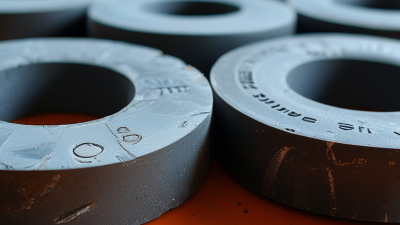
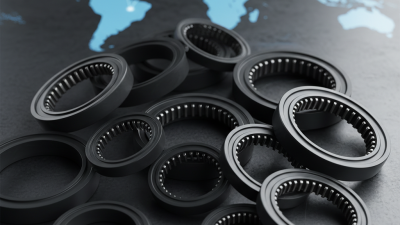
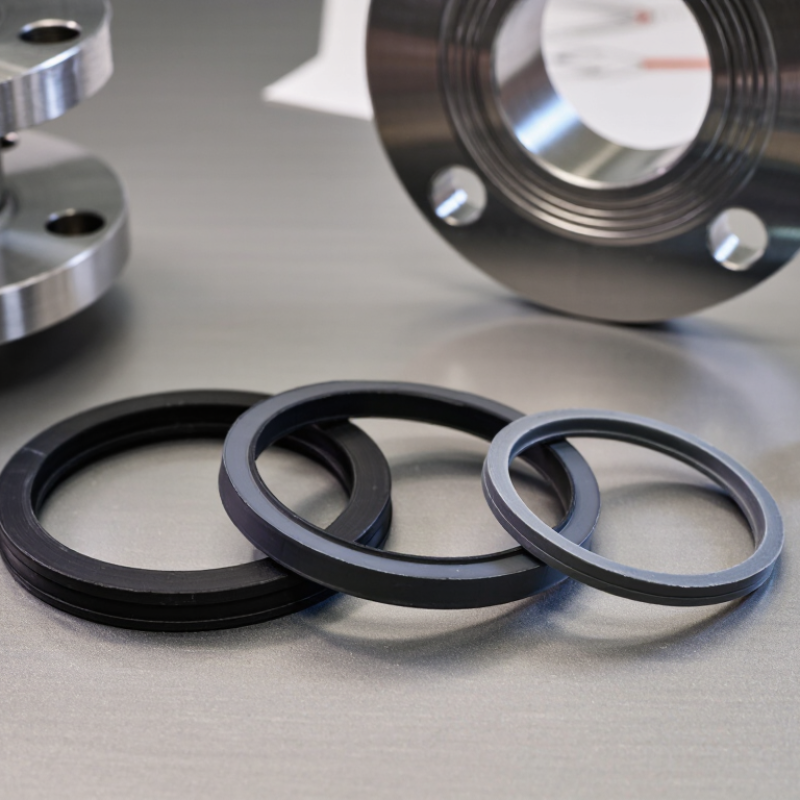
A flat rubber sealing ring is a flexible, donut-shaped component with a circular opening. Its basic structure includes an inner diameter, outer diameter, and controlled thickness. Unlike an O-ring, its cross-section is flat rather than round. The ring is usually molded or cut from elastomers such as NBR, EPDM, silicone, or fluorocarbon rubber.
During installation, bolts or a cover compress the ring between two surfaces. This compression fills tiny scratches and surface gaps. The rubber then creates a continuous barrier against liquids, gases, dust, and pressure loss. Material choice matters. NBR suits many oil-based fluids, while EPDM generally performs better with water, steam, and outdoor weathering.
ASTM D395 commonly evaluates rubber compression set after 22 hours at 70°C. A lower permanent deformation value usually indicates better recovery after loading. ISO 815-1 also measures compression set under defined temperature and time conditions. These figures help engineers compare compounds, but they cannot replace testing with the actual fluid and temperature.
Tips: Measure the groove, not only the old ring. Check inner diameter, outer diameter, thickness, surface finish, and compression space. A ring that looks correct may still leak if it is over-compressed. This detail is often overlooked. I have also seen installation errors blamed on material quality, although a twisted or scratched ring was the real cause. Avoid stretching flat rings during assembly. A small mistake can change the sealing line.
| Data Dimension | Typical Definition or Value | Technical Description |
|---|---|---|
| Product Definition | Flat rubber sealing ring | A circular, flexible sealing element with a flat or rectangular cross-section. It is compressed between mating surfaces to reduce or prevent leakage. |
| Primary Function | Static sealing | It seals stationary joints such as covers, flanges, inspection ports, housings, and pipe connections. It is generally not intended for continuous sliding movement. |
| Basic Geometry | Annular ring | The seal consists of an outer circumference, an inner circumference, and a continuous sealing land between them. |
| Cross-Section | Flat or rectangular | The cross-section normally has two broad sealing faces and a relatively small thickness compared with its inside and outside diameters. |
| Sealing Mechanism | Elastic compression | Fastener load or assembly pressure compresses the rubber against the mating surfaces. The material attempts to recover its original shape and maintains contact pressure. |
| Leakage Control | Blocks fluid and gas paths | The compressed ring fills small surface irregularities and limits the passage of liquids, gases, dust, and other contaminants through the joint. |
| Common Materials | EPDM, NBR, silicone, FKM, and natural rubber | Material selection depends on temperature, fluid compatibility, ozone exposure, weathering, compression behavior, and required service life. |
| Typical Hardness | Approximately 40–90 Shore A | Softer compounds generally conform more easily to surface imperfections, while harder compounds can provide greater resistance to extrusion and compression. |
| Typical Thickness | About 1–10 mm | Actual thickness is selected according to the joint design, available groove or flange space, required compression, and dimensional tolerance. |
| Temperature Capability | Material-dependent | Service limits vary by compound. General rubber sealing materials may cover roughly −50°C to +200°C, but the applicable range must be confirmed for the specific formulation and environment. |
| Compression Requirement | Controlled compression | The joint should compress the ring enough to create continuous contact without excessively crushing the material. Excessive compression can cause permanent deformation and premature failure. |
| Contact Surfaces | Flat, clean, and sufficiently smooth | Mating surfaces should be free from burrs, cuts, corrosion, oil contamination, and sharp edges that could damage the seal or create leakage channels. |
| Pressure Resistance | Dependent on design and material | Pressure capability is influenced by rubber hardness, seal thickness, gap size, compression, temperature, fluid type, and the use of anti-extrusion support where necessary. |
| Installation Position | Between two mating components | The ring is placed in a recess, on a flange, or against a sealing face before the components are assembled and tightened. |
| Recommended Installation Practice | Align without twisting or stretching | The ring should lie flat, remain centered, and avoid wrinkles, pinching, sharp tools, and excessive stretching. A compatible lubricant may be used when permitted by the application. |
| Common Applications | Flanges, covers, valves, pumps, tanks, and housings | Flat rubber rings are used in water systems, pneumatic equipment, hydraulic assemblies, automotive components, appliances, and general industrial machinery. |
| Main Advantages | Simple, flexible, and economical | They are easy to manufacture and replace, require limited installation space, and can accommodate minor surface irregularities when properly compressed. |
| Common Failure Modes | Compression set, cuts, swelling, hardening, and extrusion | Failure may result from incompatible fluids, excessive heat, over-compression, insufficient compression, aging, incorrect dimensions, rough surfaces, or excessive pressure gaps. |
| Inspection Criteria | Dimensions, surface condition, and elasticity | Check the inside diameter, outside diameter, thickness, cracks, tears, blisters, permanent flattening, contamination, and signs of chemical or thermal damage. |
| Replacement Guideline | Replace when damaged or permanently deformed | A sealing ring should normally be replaced after removal if it shows compression set, surface damage, swelling, hardening, or any loss of resilient recovery. |
| Key Selection Factors | Size, material, hardness, temperature, pressure, and media | Correct selection requires matching the ring to the joint dimensions and the actual operating conditions, including the fluid or gas being sealed. |
| Important Limitation | Not universally suitable for dynamic sealing | A flat rubber ring can wear quickly when exposed to continuous reciprocating or rotary motion unless the design specifically supports dynamic operation. |
| Best-Practice Summary | Correct fit plus controlled compression | Reliable performance depends on suitable rubber, accurate dimensions, compatible operating conditions, clean sealing faces, proper alignment, and uniform assembly pressure. |